+65 97307760, +65 84206285

It doesn’t matter where or how you started. For we know every single path to bring you on the top of the world.
Microgrids revolutionize power generation as localized networks integrating distributed resources like solar, wind (future), and CHP for faster, more efficient energy than traditional centralized grids. They enable islanding for resilience during outages and reduce transmission losses. CIOT’s automation platforms optimize these for mfg plants, supporting Green Mark goals.
Local sources cut losses (5-10% vs. traditional grids) and integrate renewables seamlessly.
| Aspect | Microgrids | Traditional Grids |
|---|---|---|
| Structure | Localized, multi-source | Centralized, long-distance |
| Reliability | High (islanding capable) | Vulnerable to cascades |
| Renewables | Easy integration | Limited by infrastructure |
| Efficiency | Minimal losses | High transmission waste |
Microgrids are crucial for E-mobility systems, powering EV charging stations locally with renewables and storage to slash transmission losses from distant traditional grids. This ensures reliable, efficient charging for battery vehicles along routes, reducing costs and emissions. CIOT delivers top-tier management for these integrated setups in our clients locations.
Key Benefits
• Grid Relief: Local generation avoids overloads, supports peak shaving.
• Resilience: Islanding during outages keeps chargers running.
• Sustainability: Renewables lower carbon footprints, aiding Green Mark
CIOT Solutions
CIOT integrates microgrids with smart sequencing for your plant’s E-mobility, optimizing via Front-End Design. Contact for customized deployment.
Microgrids for E-Mobility: Powering Efficient EV Charging Microgrids enable reliable, efficient EV charging with local renewables and storage, cutting transmission losses and emissions. CIOT delivers top-tier management for integrated setups. Key Benefits
– Grid Relief: Local generation avoids overloads and supports peak shaving, reducing strain on traditional grids and minimizing congestion.
– Resilience: Islanding during outages keeps chargers running, ensuring uninterrupted EV charging and supporting critical transportation infrastructure.
– Sustainability: Renewables lower carbon footprints, aiding Green Mark certifications and supporting eco-friendly operations.
– Cost Efficiency: Reduced transmission losses and optimized energy usage lower operational costs for EV charging infrastructure.
– Scalability: Modular design allows easy expansion to meet growing EV charging demands.
CIOT integrates microgrids with smart sequencing for your E-mobility needs. Let’s discuss customized deployment.
Smart charging sequencing from CIOT prevents grid overloads by intelligently managing power across EV charging stations, restricting flow to idle ones via internet connectivity. This collaboration with energy giants enables operators to optimize loads in real-time, saving substantial energy in industrial or fleet settings. It integrates with plant automation for seamless E-mobility support.
Power Management Techniques
Systems use dynamic load management (DLM) to monitor grid capacity and redistribute power via algorithms like First-in-First-Out (FiFo) or balanced distribution, avoiding peaks. Cloud-based platforms (CPMS/CSMS) provide remote control, session scheduling, and alerts for efficient operation without infrastructure upgrades.
Energy Savings and Safety
By prioritizing active stations and curtailing idle ones, sequencing cuts bills up to 45% through peak shaving and off-peak scheduling. Real-time monitoring with EMS integration ensures compliance and fault isolation, protecting against surges.
CIOT Integration Benefits
CIOT’s solution connects your E-mobility ecosystem to existing plant systems via PLCs and SCADA, using Front-End Engineering Design for custom timelines. Contact our team for a tailored quote to implement this grid-friendly automation.
Energy consumers can earn revenue by reducing or shifting electricity use during peak wholesale prices. Get paid for lowering grid consumption, by temporarily reducing usage or switching to battery power at pre-agreed times
Demand Response has been present in the Singapore market for some time now. It has evolved and, with most steps, become more lucrative for participants.
Key points 2024 onwards:
– Diesel generators, steam turbines, and other energy generation sources are not allowed to participate, to prevent investment in less efficient energy sources.
– Trial period of 6 months for new Load Registered Facilities, with 2 event concessions
– Revised penalty formula such that during TPC activations
– BESS-enabled Energy Generation is allowed to participate as a Demand Response Asset
– A sandbox program is announced for BESS participation (greater than 1 MW and less than MW)
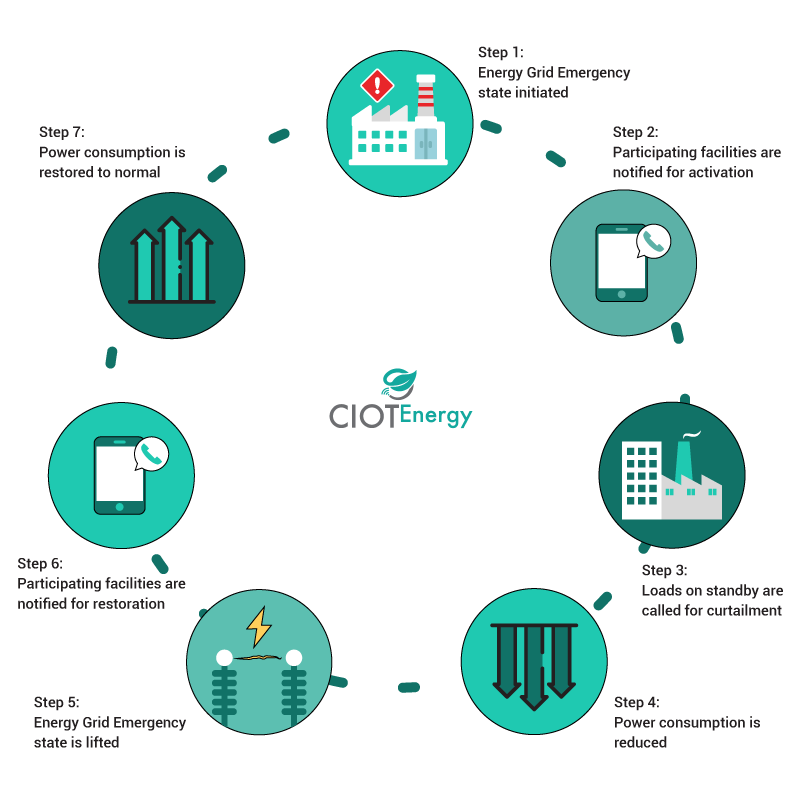
What is Interruptible Load (IL)
Energy consumers get paid to be available to curtail/shift load in the of-chance the grid needs support. i.e. be paid to provide contingency reserves to the grid.
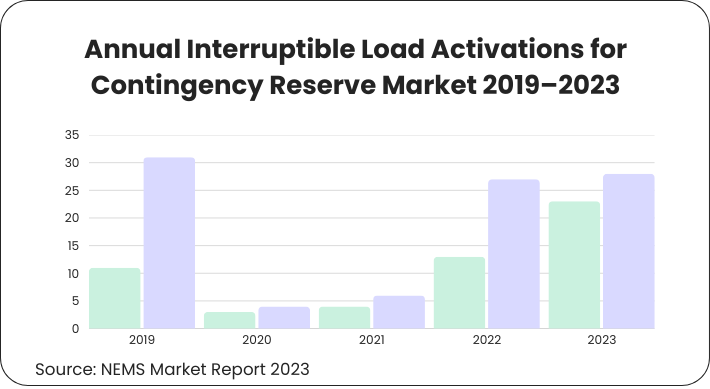
The Interruptible Load (IL) Program enables Energy consumers to get paid to be available to curtail/shift load in the off-chance the grid needs support. This offers a fixed additional stream of revenue for the energy user. This document looks at the payouts from participating in the program, based on historical data published by EMC. All new IL participants are automatically signed up to provide contingency reserve A & are paid as per dynamic contingency reserve A prices (CONRESA, $/MwH). While participating in the program, has an assured payout (as long as load interruption obligations are met), the amount of payout would depend on the reserve prices.
Get prompt responses from a friendly, professional and knowledgable support team.
Please refer: https://www.emcsg.com/f146,
(Source: EMC website)
Please refer: https://www.emcsg.com/f146,
(Source: EMC website)
No exact percentages are available for microgrid CHP usage, but most microgrids under 10 MW rely on reciprocating engines rather than turbines. Reciprocating engines dominate smaller installations due to their operational flexibility, higher fuel efficiency (up to 80% total CHP efficiency), and lower costs. Turbines suit larger plants or steam-priority applications but are less common in microgrids.
Reciprocating Engines Prevalence
In microgrids below 10 MW, reciprocating engines are the go-to for CHP because they start quickly, handle variable loads from renewables, and recover heat effectively from exhaust and cooling. They achieve 70-80% overall efficiency, outperforming turbines at part-load. Examples include natural gas-fired units anchoring hybrid solar-wind setups.
Turbine Usage
Turbines appear in bigger microgrids or where high-temperature steam drives processes, offering 70-80% efficiency but with poorer part-load performance. They require steady baseloads, making them less ideal for fluctuating microgrid demands.
Selection Rationale
Engines win for microgrids’ need for rapid response and heat flexibility, complementing intermittent sources like solar. CIOT’s smart energy solutions, including CHP integration, tailor these for grid stability in your plant.
Typically, the battery supplier offers a recycling program for the batteries at the end of their life.
Power quality requirements are site specific and are taken into consideration when choosing the mix of generation assets.
In the examples spoken about in the webinar, the reactive power is controlled via the voltage controller on the alternator. The information is gathered within the microgrid controller and then sent to the resource(s) best used to address the reactive power. Then the controller for that(those) resource(s) adjusts the settings of the automatic voltage regulation to properly share reactive power as demanded by the Microgrid controller.
MTU uses the HOMER tool to model microgrids.
Every installation is different, therefore a site-specific analysis would need to be done to include all factors affecting payback.
Yes, if the genset and battery storage solutions are supplied by MTU. If there are third-party generator sets, then custom engineering will develop defined interfaces to allow for this functionality.
As noted in the webinar, emissions are one of the first parameters to address when designing a microgrid. Generally, emissions are something that have to be looked at from a systems approach for each site and what is the best solution for the client.
Most utilities have interconnect requirements for battery system, just as they do for generator sets. Our recommendation would be to inquire through the local utility to get this information.
This depends on how much of the electricity generated by the PV needs to be stored and how much is consumed. Webinar 201 will talk more about battery storage. For reference purposes, a battery storage system with 2.000 kilowatt peak power and 1,000 kilowatt/hour capacity would come as a 40–foot ISO container.
The hospital in this case did not have a renewable aspect. Yes, biogas is considered to be a renewable fuel.
First and foremost, regulatory compliance must be met from both the federal and regional requirements. Once those areas are addressed the requirement for the connection to the local utility need to be addressed.
Yes, most installations are behind the meter with net metering done by the controls to ensure that the generation matches site load and no power is exported.
Typically, the generator sets are sized for continuous operation thus they have 100% load factor capability.
Maintenance is done during times when the plant load is low, eg. weekends or nights.
Pyrolysis gas is typically not suitable for combustion in reciprocal engines due to its composition.
Within the U.S., these would be stationary applications at permanent bases.
Engine driven generators are far more widely used in microgrids as they offer better fuel efficiency, lower cost/kilowatt and cover a wider range of power nodes compared to microturbines.
Diesel generators combined with solar and battery storage.
Yes, it can be done with project–specific engineering.
This depends on the arrangement with the local utility and what rates they will pay. This may also differ depending on what generation asset is producing power as renewable power may have attractive rates for export. Typically, microgrids will however operate behind the meter or in island mode
Most are between 480 volts to 13 kilovolts.
There are several solutions to mitigate wet stacking. Being this is a known condition it can be programed into the microgrid controller to adjust load from one resource to another. Thus, the resource that is entering a wet stacking condition can take on a larger percentage of the load. If there was a load bank on-site that could be used as well, but it probably isn’t the most efficient solution for a microgrid, but could be a part of the solution for contingency planning if needed. The final solution would depend on what power generating resources are available at the specific site.
With domestic oil & gas production continuing to grow, gas prices are projected to stay stable in the near future. Profitability will also depend on electricity price developments compared to natural gas prices. Also called spark spread. If both prices rise, it will have less of an impact on ROI.
Typically, microgrid systems are not used as an emergency power source. The reason for this is mostly due to the cost. However, it may use one power generating resource to reduce the electrical demand from the utility and if the utility fails have additional resources that can be dispatched when needed. For example, a health care facility may use a combined heat and power unit 24/7 as a base load electrical demand and heat recovery. When the utility fails the site may have diesel units (or some other asset) that can be dispatched to allow the facility to operate like normal.
Expert independent energy and IoT consultants that implement customised client solutions in the areas of Energy Management – Metering and Software and IoT – Asset Management.

© 2025 CIOT Energy Pte. Ltd.